Meat Temperature Chart: The Complete Guide to Safe Internal Temps
Know exactly when your meat is done. Complete internal temperature guide for beef, chicken, pork, fish, and more — with doneness levels.
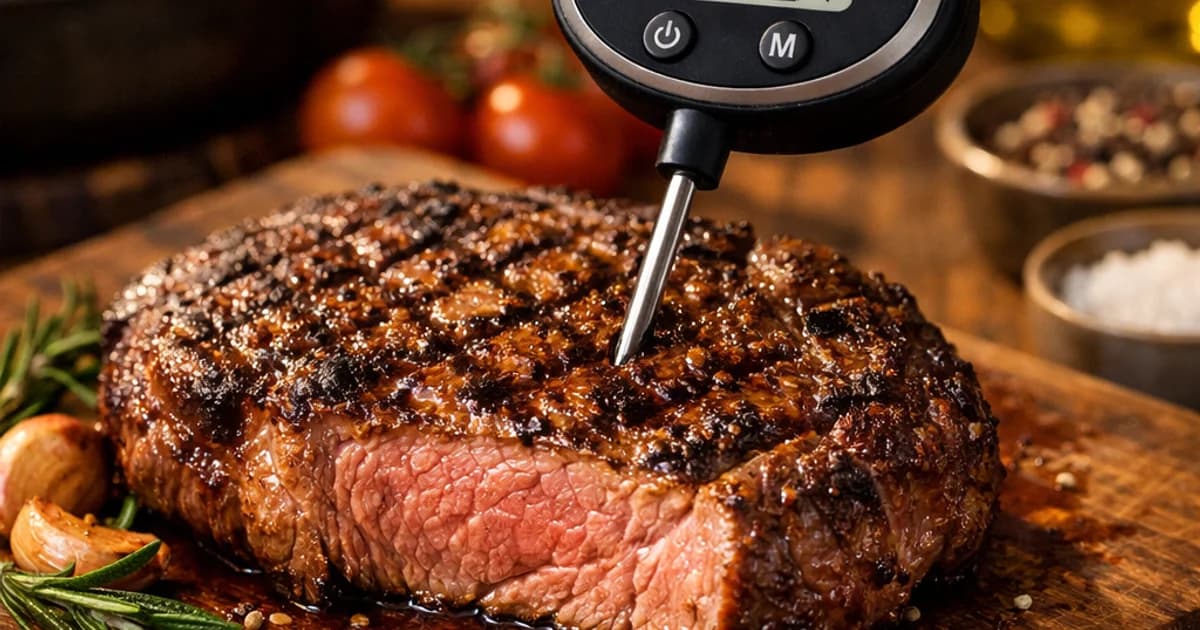
Cooking meat to the right internal temperature is the single most important thing you can do for both food safety and quality. It is also one of the most misunderstood skills in the kitchen.
Cut the chicken too early and you risk undercooking it. Leave the steak on too long and you have a dry, expensive disappointment. Even experienced home cooks rely on guesswork — pressing the meat, watching the juices, or timing by the clock — when the only truly reliable method is a thermometer.
Internal temperature tells you what is actually happening inside the meat, not just at the surface. Two steaks of the same weight on the same grill can cook at completely different rates depending on their starting temperature, thickness, and fat distribution. The thermometer removes all that uncertainty.
This guide gives you a complete reference for beef, lamb, poultry, pork, and fish, along with practical advice on using a thermometer correctly and understanding why resting time matters as much as cooking time.
Free Tool
Cooking Temperature Guide
Look up safe cooking temperatures for any protein with our free reference tool.
Beef and Lamb Temperature Chart
Beef and lamb are the proteins with the widest range of acceptable doneness levels. Unlike poultry, the muscle tissue of whole cuts of beef and lamb does not harbor pathogens throughout — harmful bacteria live on the surface, which reaches high temperatures during cooking. This is why a rare steak is safe while a rare chicken breast is not.
The USDA recommends a minimum internal temperature of 145°F (63°C) for whole cuts of beef and lamb, followed by a three-minute rest. Most chefs and home cooks prefer medium-rare at 130–135°F for steaks, which is a personal preference rather than a safety concern with whole cuts.
Note that ground beef is different. Because grinding distributes surface bacteria throughout the meat, ground beef must always reach 160°F (71°C) with no exceptions.
| Doneness | Internal Temp (°F) | Internal Temp (°C) | Description |
|---|---|---|---|
| Rare | 120–125°F | 49–52°C | Deep red center, very soft |
| Medium-Rare | 130–135°F | 54–57°C | Warm red center, juicy |
| Medium | 140–145°F | 60–63°C | Pink center, firmer texture |
| Medium-Well | 150–155°F | 65–68°C | Slight pink, noticeably firmer |
| Well-Done | 160°F+ | 71°C+ | No pink, fully firm |
| Ground Beef (USDA minimum) | 160°F | 71°C | No exceptions for ground meat |
| Beef/Lamb (USDA minimum whole cut) | 145°F | 63°C | With 3-minute rest |
For roasts and thick cuts like prime rib, pull the meat 5–10°F below your target temperature. Carryover cooking during the rest period will bring it up to the final temperature without overshooting.
Poultry Temperature Chart
Chicken and turkey have one rule: 165°F (74°C), measured at the thickest part of the meat. There is no "medium-rare" for poultry. There are no exceptions based on preference or cooking method.
Salmonella and Campylobacter, the bacteria most commonly associated with poultry, are present throughout the muscle tissue — not just on the surface. The only way to eliminate them reliably is to reach the target temperature all the way through.
| Cut | Internal Temp (°F) | Internal Temp (°C) | Notes |
|---|---|---|---|
| Chicken breast | 165°F | 74°C | Check at thickest point |
| Chicken thighs and legs | 165°F | 74°C | Dark meat is safe and often better at 175°F |
| Whole chicken | 165°F | 74°C | Check between thigh and body |
| Ground chicken or turkey | 165°F | 74°C | No exceptions |
| Turkey breast | 165°F | 74°C | Insert thermometer horizontally |
| Whole turkey | 165°F | 74°C | Check thigh, not the stuffing |
| Duck | 165°F | 74°C | Skin renders best above 170°F |
One practical note on chicken thighs: while 165°F is the safe minimum, the connective tissue in dark meat breaks down better at slightly higher temperatures. Many cooks prefer pulling thighs at 175–185°F for better texture. This is not a safety upgrade — 165°F is already safe — it is a quality choice.
Warning
Never eat undercooked poultry. Unlike beef or lamb, chicken and turkey carry pathogens throughout the muscle, not just on the surface. A pink center is not a style preference with poultry — it is a food safety issue. Always verify temperature with a thermometer rather than relying on color alone. Cooked chicken can appear pink near the bone even when fully safe, and fully cooked chicken can look white even before it reaches temperature.
Pork Temperature Chart
Pork has a more recent story. For decades, the USDA recommended cooking pork to 160°F, partly out of concern for trichinosis, a parasitic infection caused by Trichinella. In 2011, the USDA updated its guidelines and lowered the safe minimum for whole cuts of pork to 145°F with a three-minute rest — the same as beef.
Modern commercial pork in the United States and most of the world is produced under conditions that effectively eliminate trichinosis risk. Cooking pork to medium (145°F) is safe and produces noticeably juicier, more tender results than the well-done style many people grew up eating.
Ground pork, like ground beef, still requires 160°F due to the distribution of surface bacteria through grinding.
| Doneness | Internal Temp (°F) | Internal Temp (°C) | Notes |
|---|---|---|---|
| Medium (USDA minimum) | 145°F | 63°C | With 3-minute rest — slightly pink, juicy |
| Medium-Well | 150–155°F | 65–68°C | Very light pink, firmer |
| Well-Done | 160°F+ | 71°C+ | No pink, traditional style |
| Ground pork | 160°F | 71°C | No exceptions |
| Pork ribs | 190–203°F | 88–95°C | Low-and-slow — collagen breakdown |
| Pulled pork (shoulder) | 195–205°F | 91–96°C | Fork-tender, connective tissue rendered |
Ribs and pulled pork are worth addressing separately. The USDA minimum applies to food safety, but cuts like pork shoulder and ribs need to go far beyond 145°F for the cooking method to work. The collagen in these tougher cuts must convert to gelatin, which happens at prolonged exposure to temperatures around 190–205°F. They are food-safe long before they are tender.
Fish and Seafood Temperature Chart
Fish cooks faster than most people expect, and it is easy to overcook. The USDA minimum for fish is 145°F (63°C), at which point the flesh should be opaque and flake easily. In practice, many fish are excellent — and technically safe — slightly below this if they are sushi-grade or previously frozen, but for home cooking without verified sourcing, 145°F is the standard.
Shellfish are best cooked until the shells open (for clams, mussels, and oysters) or until the flesh turns from translucent to opaque (for shrimp and scallops). Temperature readings are harder to get reliably on smaller shellfish.
| Type | Internal Temp (°F) | Internal Temp (°C) | Visual Cue |
|---|---|---|---|
| Fish fillets (general) | 145°F | 63°C | Opaque, flakes with fork |
| Salmon | 125–130°F | 52–54°C | Preferred by most for texture; FDA minimum 145°F |
| Tuna steaks | 125–130°F | 52–54°C | For seared/rare style; FDA minimum 145°F |
| Shrimp | 120°F | 49°C | Flesh opaque, pink, slightly curled |
| Scallops | 130°F | 54°C | Opaque center, slight firmness |
| Lobster | 140°F | 60°C | Flesh white and firm |
| Clams, mussels, oysters | N/A | N/A | Cook until shells open |
Salmon deserves a note on the gap between the FDA guideline and common practice. Many professional cooks and home cooks pull salmon at 125–130°F for a silkier, more moist texture. If you are buying high-quality, fresh salmon from a trusted source, this is a widely accepted approach. For vulnerable individuals — pregnant women, young children, elderly, or immunocompromised — stick to the FDA minimum of 145°F.
How to Use a Meat Thermometer Correctly
A thermometer is only as accurate as how you use it. Several common mistakes produce misleading readings.
Insert into the thickest part of the meat. This is where heat penetrates last. If the thickest part is done, everything else is done. Inserting into a thin edge gives you a falsely high reading.
Avoid bone, fat pockets, and cavities. Bone conducts heat differently than muscle tissue and will give you an inaccurate reading. Fat pockets can be several degrees hotter than the surrounding meat. Always insert the probe into solid muscle.
For whole birds, check multiple spots. The thigh and the breast cook at different rates. The thigh near the joint is typically the last to reach temperature. Check both.
Wait for the reading to stabilize. Instant-read thermometers still take 2–3 seconds to give a final reading. Some budget models take longer. Pulling the thermometer too early gives you a transitional number, not the actual temperature.
Calibrate your thermometer regularly. Fill a glass with ice water. A properly calibrated thermometer should read 32°F (0°C) in an ice bath. If it does not, check the manufacturer's instructions for recalibration or factor in the offset.
Use a leave-in probe for thick roasts. If you are cooking a large beef roast or whole turkey, a probe thermometer with a heat-safe cable lets you monitor temperature without opening the oven repeatedly. This prevents heat loss and gives you a continuous read.
Tip
When you pull meat off the heat, the cooking is not over. The exterior of the meat is hotter than the interior, and that heat continues to move inward during the rest period — a process called carryover cooking. For steaks and chops, this raises the internal temperature by 5°F. For large roasts and whole birds, it can add 10–15°F. Always pull your meat below your target temperature and account for carryover. A steak you want at 135°F should come off the grill at 125–130°F.
The Importance of Resting Time
Resting is not optional. When meat is under heat, the muscle fibers contract and push moisture toward the center of the cut. If you cut it immediately, that juice runs out onto your board. When you let the meat rest, the fibers relax and reabsorb the moisture. The result is a noticeably juicier bite throughout.
Resting also completes the carryover cooking process, which means it is both a quality step and the final stage of food safety.
| Meat Type | Minimum Rest Time | Notes |
|---|---|---|
| Thin steaks (under 1 inch) | 3–5 minutes | Tent loosely with foil |
| Thick steaks (1 inch or more) | 5–10 minutes | Rest uncovered or loosely tented |
| Pork chops and tenderloin | 3–5 minutes | Retains significant moisture |
| Bone-in pork shoulder | 20–30 minutes | Essential for pulling |
| Whole chicken | 10–15 minutes | Redistributes juices throughout |
| Whole turkey | 30–45 minutes | Large mass needs time to equalize |
| Beef roast (prime rib, etc.) | 15–20 minutes | Temperature rises 10–15°F during rest |
| Rack of lamb | 5–10 minutes | Loosely tented with foil |
| Fish fillets | 2–3 minutes | Minimal but worth doing |
Tenting loosely with aluminum foil helps retain heat during the rest without trapping steam, which would soften any crust you built up during searing or roasting. Tight wrapping causes steam accumulation and defeats the purpose.
Key Takeaway
The internal temperature of meat is the only reliable indicator of doneness and food safety. Use a calibrated instant-read thermometer, insert it into the thickest part away from bone, and pull meat 5–10°F below your target temperature to account for carryover cooking during the rest period. For poultry, the answer is always 165°F — no exceptions. For whole cuts of beef, lamb, and pork, the USDA minimum is 145°F with a three-minute rest. Ground meat of any type always requires 160°F.
Understanding cooking temperatures pairs well with knowing which cooking method is right for each cut. If you are planning meals that include oven roasting and air frying, the tradeoffs between those two methods affect cooking times and temperatures. The Air Fryer vs Oven Guide covers how heat circulation differences change cooking times and when to adjust your temperature targets accordingly.
Knowing the safe internal temperatures for every protein is just one part of building consistent, reliable meal routines. The other part is having a plan. UseMealPlanner helps you generate weekly meal plans built around your preferences, so you are not starting from scratch every Sunday afternoon wondering what to make.
Free Tool
Cooking Temperature Guide
Look up safe cooking temperatures for any protein with our free reference tool.
Ready to simplify your meal planning?
Join UseMealPlanner and get AI-generated recipes tailored to your preferences, dietary needs, and schedule.
Start Cooking Free